
Greenland Energy Moves to Acquire 80 Mile in a £61.5 Million All-Share Deal
GLND already owns 4.42 percent of 80 Mile, is offering a 46.7 percent premium for the rest, and has until October 6 to make it firm. The Nasdaq company that controls most of Jameson Land is buying all of it.
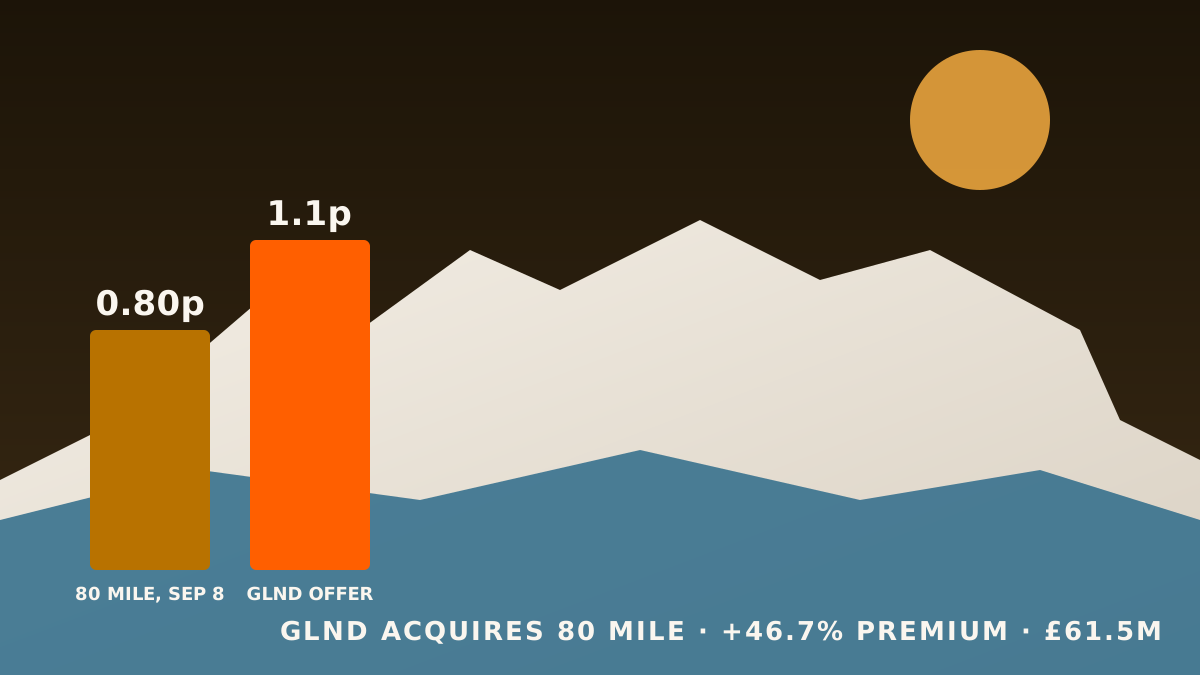
Greenland Energy Company (Nasdaq: GLND) spent the last two weeks of August quietly buying shares of 80 Mile plc (AIM: 80M) on the open market. On Monday it stopped being quiet. GLND set out indicative terms to acquire the whole of 80 Mile in an all-share deal that values the AIM company at about £61.5 million, or roughly 1.1 pence per share, and 80 Mile stock jumped 7 percent to 0.80p on the news.
The mechanics are simple. Each 80 Mile share would convert into 0.01108 new GLND common shares. At Monday's prices that works out to a 46.67 percent premium to 80 Mile's September 7 close, a 42.86 percent premium to where it traded on September 3, and a 64.18 percent premium to the price of 80 Mile's July placing. Because the consideration is stock, the sterling value will move with GLND's share price and the dollar-pound rate between now and closing, which is the sort of detail that arb desks read twice.
GLND did not show up empty handed. Between August 25 and September 3 it bought 246.7 million 80 Mile shares at prices from 0.53p to 0.82p, a weighted average of 0.73p, and as of September 8 holds 4.42 percent of the company. Buying a toehold before you announce terms is an old habit in UK takeovers. It tells the target's board you are serious, and it tells the market you were happy to pay less than the offer price a week ago.
What GLND is buying: 80 Mile holds the minority interest in the Jameson Land oil exploration licences in East Greenland, the same basin where GLND already holds the majority and has lined up Halliburton for its 2026 drilling program. Taking over 80 Mile puts 100 percent of Jameson Land under GLND's roof, which matters when you are trying to finance a well and every partner has a different balance sheet. 80 Mile also brings the Disko-Nuussuaq copper, nickel, cobalt and platinum group metals project in West Greenland, the Dundas ilmenite project in the northwest, and smaller interests in Finland and Italy. In other words, GLND goes from being an oil story to being an oil-plus-critical-minerals story in a single transaction, at a moment when Greenland's rocks are getting more political attention than at any point in living memory.
Larry Swets, GLND's executive chairman, said recent developments had reinforced the logic of bringing the two companies together and that now was the time to pursue it in earnest. Read that as: the acquirer has decided, and the price is on the table. Executive chairmen say things like that. The 4.42 percent stake is what says it louder.
The conditions are the usual set. GLND wants confirmatory due diligence and a unanimous recommendation from 80 Mile's independent directors. 80 Mile wants satisfactory reverse due diligence on GLND, plus sign-off from GLND's disinterested directors. Under UK takeover rules GLND has until October 6 to either announce a firm intention to make an offer or walk away, which gives the market four weeks to decide whether 0.80p is cheap against an implied 1.1p, or whether the gap is the price of the paperwork.
The desk take: the spread is wide, the acquirer already owns a piece, and the deadline is public. That is either a fairly standard UK microcap takeover arb or a very cheap way to own a Nasdaq listing with Greenland oil and critical minerals attached, with GLND as the consolidator either way. We will know which by October 6.