
Washington Owns 35 Percent of a Venezuelan Oil Company. Its First Tanker Just Docked in Texas. The Arctic Is Next on the List.
The Trump administration has taken equity in some 40 companies in 18 months, from Intel to rare earths to a Venezuelan driller. Most of those stocks ripped on the day the check landed. With Brent near $115 and a renewed Iran campaign reportedly penciled in for after the midterms, the next line in the portfolio points north.

On Tuesday afternoon the President stood at the Port of Corpus Christi, pointed at a tanker, and told the crowd it was carrying a million barrels of Venezuelan crude, a gift, “the greatest oil victory in history.” On Wednesday morning the company that produced it put out a press release confirming the first NABEP cargo under the U.S. agreement had arrived in Texas. The part worth reading twice is who NABEP is. North American Blue Energy Partners is the private venture, fronted by Venezuelan businessman Alejandro Betancourt, in which the Pentagon's Office of Strategic Capital agreed in August to take a 35 percent stake through penny warrants, with the right to buy 20 percent of its production at cost. Seventeen fields. Sixty-five billion barrels of reserves under the agreement. Output of 223,509 barrels of oil equivalent a day as of October 19, up from about 18,000 two years ago. A sixth drilling rig arrived this week. A State Department delegation toured the fields on Thursday and Friday and the chargé d'affaires said, on the record, “American rigs are putting Venezuelans to work, and Venezuelan oil is strengthening America's energy security.”
The U.S. government does not have a national oil company. It now has something close to a 35 percent interest in one, and the first barrels from it are being refined in Texas. That is the context for everything below.
The portfolio, and what it did to the tape
Count it however you like. The Cato Institute puts the administration's equity positions at 40 companies; the Council on Foreign Relations counts 43 if you include the Development Finance Corporation. Fortune counted 30 in July. A Treasury spokesperson told reporters this week that agencies report equity “in different ways,” which is a polite way of saying nobody in Washington keeps the master list. The desk keeps one. The names that matter for the price action:
Intel. August 2025. The Commerce Department converted CHIPS Act grants into 433.3 million shares at $20.47, a 9.9 percent stake worth about $8.9 billion at the time, plus a five-year warrant for another 5 percent at $20. Intel closed Tuesday at $93.74. The taxpayer's position is worth roughly $40 billion on paper. Whatever you think of the policy, that is the single best trade the U.S. government has made this century.
MP Materials. July 10, 2025. The Pentagon bought $400 million of preferred stock convertible at $30.03, took warrants on 11.2 million shares, capped itself at 19.9 percent, banned exports to China and, crucially, wrote the company a price floor for its rare earths. The stock rose about 50 percent that day and ran to $76.80 at the high. It closed Tuesday at $40.87, up 9 percent on the session, with a $7.3 billion market value.
Lithium Americas. September 30, 2025. A 5 percent slice of the company and 5 percent of the Thacker Pass joint venture, carved out of a renegotiated $2.26 billion Department of Energy loan. Shares jumped more than 20 percent on confirmation after a 40 percent after-hours spike the night the news leaked.
Trilogy Metals. October 7, 2025. $35.6 million for 10 percent plus warrants for 7.5 percent more, alongside an executive order telling agencies to permit the Ambler road in Alaska. The stock closed up 211 percent. In one day.
USA Rare Earth. January 26, 2026. A $1.6 billion package, $277 million of it direct federal money and $1.3 billion a CHIPS loan, for an 8 to 16 percent stake, with the government getting its shares at a 31 percent discount to the prior close. The stock still rose 6 percent that afternoon and the whole rare earth complex rallied with it.
GlobalFoundries, Vulcan Elements, ReElement, Korea Zinc's Tennessee smelter, a “golden share” in U.S. Steel, and on October 22 four more CHIPS letters of intent for Helion ($175 million), Commonwealth Fusion ($85 million), Vertical Semiconductor ($73 million) and Sibelco ($56 million). Note GlobalFoundries: when Commerce doubled its stake to about 7 percent on October 14, the stock fell. The pattern is not infallible. It is just very, very consistent when the company is small and the check is large.
The mechanics are the same every time. The government does not pay up. It gets warrants, penny warrants, preferred stock, a discount or a loan conversion. It attaches a strategic condition, no exports to China, a price floor, a production purchase right. And the market reprices the company on the day, not because the cash is large but because the counterparty is permanent. A sovereign that owns 10 percent of you and has written your product into its supply chain is not going to let you fail in the next funding round. Retail figured that out by the second deal. The reaction time between Reuters headline and 100 percent gap is now measured in minutes.
Why the next check is about oil, not chips
Brent traded at $114.87 on Wednesday, WTI at $101.49. The Wall Street Journal reported that Washington has told several Gulf Arab states to prepare for a renewed military campaign against Iran after the November 3 midterms. The President said on Sunday he had “a decision to make.” Qatari mediators handed Tehran a new draft deal and Iran is supposed to answer by the end of the week. UBS raised its forecasts and now expects Brent to sit near $110 through year end, citing falling inventories, record freight rates and the fact that the strategic reserve releases pledged in the spring have now largely been completed. Gasoline is up roughly 40 percent year over year. Diesel is up closer to 75 percent. Hormuz flows, in the bank's words, “have not yet fully normalised.”
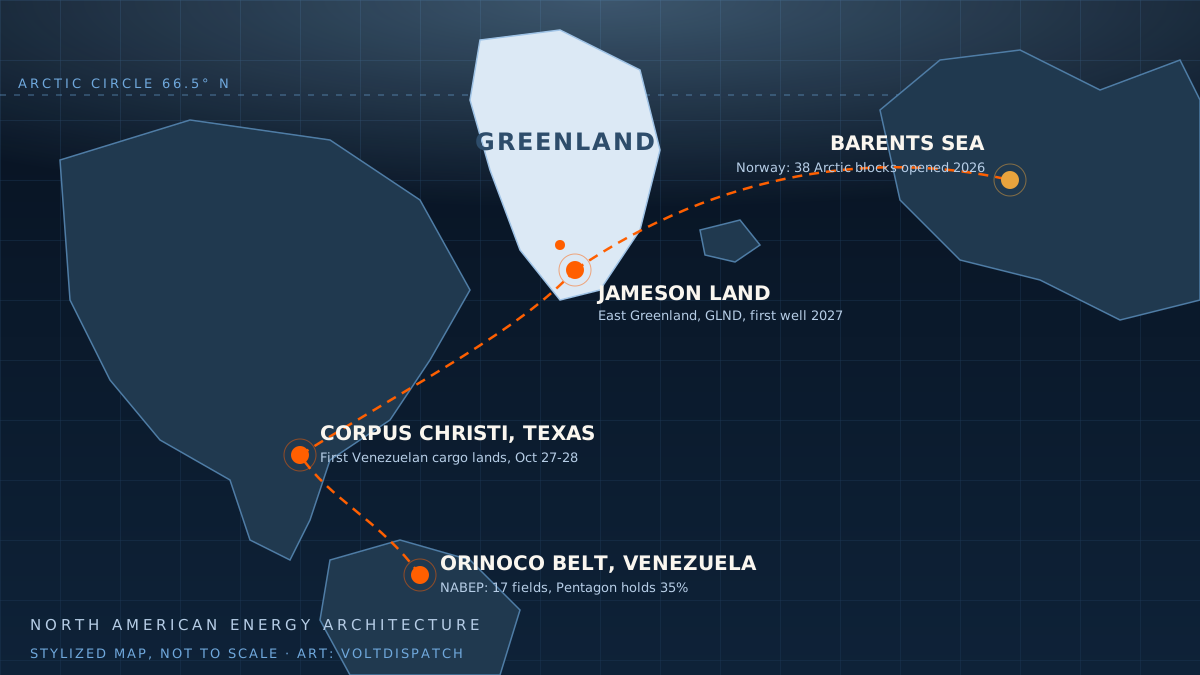
So the administration is doing what it did with chips and magnets, but for barrels: buying into supply that does not have to transit a strait it may be bombing in six weeks. Venezuela is the first move. It is the biggest reserve base in the hemisphere, it is three sailing days from the Gulf Coast refineries that were built for its heavy crude, and the White House now has a 25-year agreement and a 35 percent stake in the fastest-growing operator in the country. Chevron is adding $7 billion. Continental is in. Venezuela's own ministry expects nearly $76 billion of oil and gas investment over five years. Call it the southern anchor of a North American energy architecture that runs from the Orinoco Belt to the Arctic.
The northern anchor
On September 22 the U.S., Denmark and Greenland signed a security agreement in New York with no expiry date. It expands Pituffik Space Base, allows new U.S. installations at Narsarsuaq and Mestersvig, bars non-NATO militaries from the island and, in a clause most people skipped, mentions resource extraction and “minerals cooperation.” Three weeks later, on October 14, the President posted that “Massive Oil, Gas, and Mineral Exploration is getting ready to begin in our new and beautiful Greenland,” and claimed the easily available oil there is “far greater than that of almost any land” on earth. Nuuk declined to comment. Forbes ran the headline that Greenland rejected the claim.
The tape did not wait for Nuuk. Greenland Energy Company (Nasdaq: GLND) opened that morning at $2.26, printed $4.48 intraday and closed at $3.90, up 57 percent on the day. It gave a chunk back over the following sessions, as these things do, and sits around $3 with a market value of about $136 million on 43.7 million shares. That is the entire U.S. listed exposure to Greenland oil. There is no second ticker to type.
Here is why this desk thinks GLND is the obvious candidate for the next line in the portfolio, and why it is also nowhere near a sure thing. The case for: the company holds, through its partner 80 Mile's White Flame Energy, the only oil exploration licences in Greenland, granted in 2015 and 2018 and grandfathered under the 2021 ban on new licences. Independent engineering puts the Jameson Land basin's upside at up to 13 billion barrels, with the first drill target around 2.9 billion. Halliburton is running logistics, Stampede Drilling is contracted for an Arctic-rated rig, the environmental baseline program is complete and the filings are in. CEO Robert Price told Fox Business this week that the U.S. government “has acknowledged and is monitoring” the project, that the security agreement gives the company the “certainty in the security of Greenland for our long-term investment,” and, in the line that reads like it was written for the Office of Strategic Capital, that “it's incumbent upon the United States to look beyond the shale plays for a supply of energy moving forward.” His pitch, verbatim: if the basin works, “this could really help some of the choke points in the Middle East.” The crude, he says, matches North Sea grades, which means European refineries can run it. A $40 million first well and $20 million per well after that is a rounding error next to the $1.6 billion Washington handed USA Rare Earth.
The case against, and it is real: nothing has been drilled. Greenland's government has not changed its 2021 position on new licences, it told the company in August that the 2026-27 winter drilling window could not clear environmental and social review in time, and the first well is now a 2027 event at best. A barge full of equipment landed at Nerlerit Inaat in July before landing permission was granted, and the Ministry of Mineral Resources said so publicly. The company's own prospectus carries going concern language and notes a 2008 USGS assessment that put the chance of a technically recoverable find below 10 percent. Cash was about $37 million at the last quarter. The stock is down roughly 69 percent over twelve months even after the October spike. A government stake would not change the geology. It would change the funding risk, and in a 43 million share company that is the whole story.
Europe just blinked on the Arctic
The other piece of the backdrop is that the people who spent two decades trying to keep the Arctic closed have quietly stopped. On October 19 Bloomberg obtained a draft of the EU's new Arctic strategy that dropped every reference to a moratorium on new Arctic oil and gas drilling. The 2021 version had called for a “multilateral legal obligation” against developing Arctic reserves and a commitment not to buy hydrocarbons from such projects. The adopted text, published October 21, still says fossil fuels should stay in the ground, but the binding ban and the no-purchase pledge are gone. An EU official told Reuters the change reflected a harder geopolitical climate. Norway, which supplied nearly a third of the EU's gas last year and had lobbied Brussels hard, welcomed it, awarded five Barents Sea licences in last year's round, opened 38 Barents blocks for applications this year and put 70 new blocks on offer in its APA 2026 round. In September the EU signed a €200 million partnership package with Greenland and Denmark covering raw materials, energy and infrastructure.
Larry Swets, Greenland Energy's executive chairman, put it the way a man with a licence would: “EU dropping the ban is a strong signal reminder that the world still needs oil.” Environmental groups say the change is cosmetic, and in strict legal terms they have a point, since Brussels never had jurisdiction over Jameson Land anyway. But the signal is the point. The one body that was trying to build an international norm against Arctic oil has, with Brent above $110 and a war in the Gulf, decided it has other priorities.
The desk take
Line up the facts. A government that has taken equity in 40 companies and treats a price floor or a purchase right as a routine term sheet. A war premium of $30 a barrel that may get worse after November 3. A first tanker of Pentagon-backed Venezuelan crude being refined in Corpus Christi as of Wednesday. A permanent security agreement over the largest island on earth, with minerals cooperation written into it. A president who has said in public that Greenland's oil is about to be explored. And one Nasdaq company, with a $136 million market value, holding the only licences that would let him be right.
We are not telling you the check is coming. Nuuk has a veto, the geology has a veto, and a Democratic House in January would make every one of these deals a hearing. We are telling you that if the administration wants a northern anchor to go with its southern one, there is exactly one place to put the money, and the market has already shown you, twice this autumn, what it does on the day anyone in Washington says the word Greenland.