
Boxabl's Borrow Rate Just Hit 712%. There Is Almost Nothing Left to Short.
A float in the single-digit millions, 99.6% of lendable shares already out the door, zero shortable shares at Interactive Brokers, and a cost to borrow that would make a payday lender blush. Is $BXBL setting up for a squeeze?
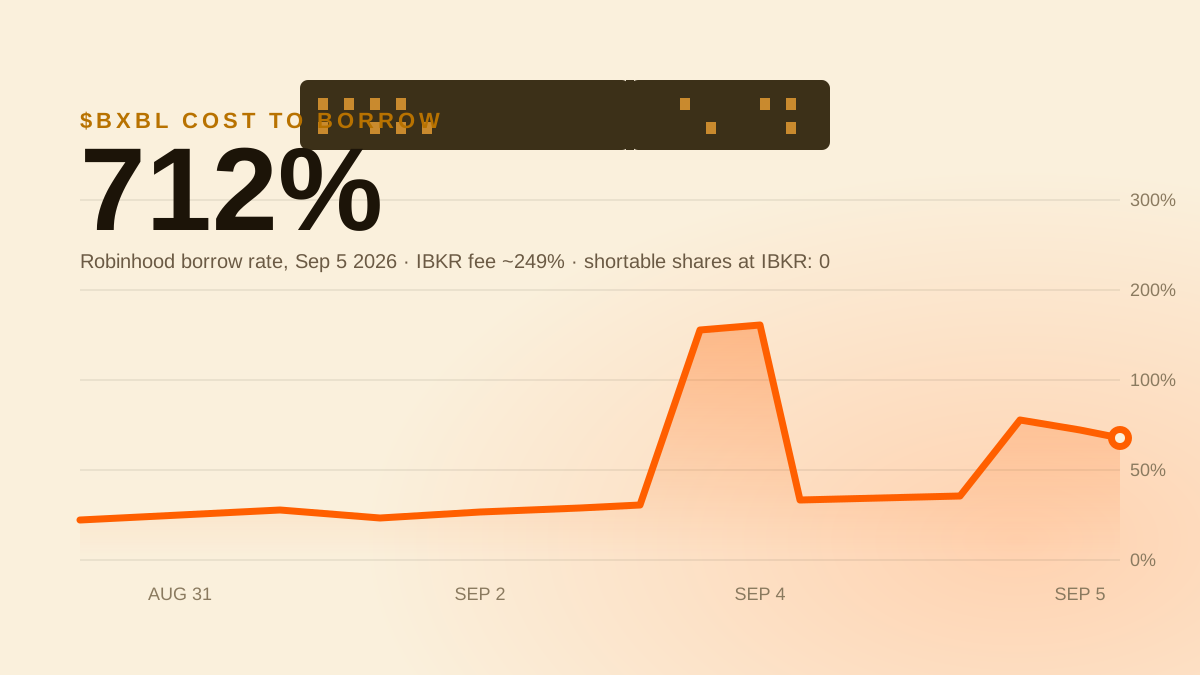
Every short squeeze starts the same way: somebody notices a number that should not exist. On Saturday morning the number was 712.00%. That is the annualized borrow rate Robinhood was quoting on BOXABL Inc. (Nasdaq: BXBL) shares, next to the words “Short inventory: None.” Over at Interactive Brokers the fee was a comparatively modest 248.83%, next to the words “Shortable shares: 0.” Two of the biggest retail brokers in the country, and neither one can find you a single share to borrow.
For the uninitiated, a borrow rate is what a short seller pays per year to rent someone else's stock so they can sell it and hope to buy it back cheaper. On a normal large-cap it is well under 1%. Anything above 20% is considered hard to borrow. At 712%, a short seller is paying roughly 2% of the position every single day just to stay in the trade. At $4.35 a share, that is about nine cents a day, per share, for the privilege of betting against a company that just signed its largest purchase agreement ever.
The securities-lending data behind that rate is where it gets interesting. As of September 3, utilization of the lendable supply in BXBL sat at 99.64%, which means practically every share that can be lent out has been. Lender depth was 2, borrower depth was 3, and the average loan had been open for 22.55 days and climbing. The one-week chart of the fee rate tells the story in a single line: it hovered around 50% to 60% for most of the past week, spiked to roughly 250% on September 4, dipped, and came right back up. Supply is gone. Price is doing what price does when supply is gone.
Why is there so little to borrow? Because there is so little stock to begin with. BOXABL came public on July 20 through its merger with FG Merger II Corp., a deal that issued roughly 350 million shares to existing BOXABL holders at a $10 deemed value, a $3.5 billion headline valuation. But most of those shares belong to the founders and to the more than 50,000 crowdfunding investors who put in over $230 million across Reg A+, Reg CF and Reg D rounds, and a large portion of that stock is not freely trading yet. Data providers list about 241 million shares outstanding, while the tradable float is a rounding error next to that. Fintel's most recent short-interest figure, 542,993 shares as of the August 14 settlement, works out to 6.86% of float, which implies a float of roughly eight million shares. Robinhood's own market-cap line, $41.21 million at $4.35, points at a similar single-digit-million number. This is a $1 billion company by share count that trades like a $40 million one.
Now stack the rest of the setup on top of that. The stock listed near the top of its range and has been sold hard ever since, from a 52-week high of $15.14 down to $3.18 before bouncing to the mid-fours. Short interest grew about 25% month over month into that decline, per MarketBeat, with days-to-cover a little over three. Friday's volume was 62,830 shares against a 231,660 average, so the tape is thin. And the borrow rate is now screaming that whoever is short is being charged like a hostage.
Then there is the news flow, which has quietly turned into a drumbeat. On September 1 BOXABL signed a multiyear agreement with LC Vegas Acquisitions for up to 1,500 homes over three years, roughly 500 a year, its largest announced residential purchase arrangement to date (with the usual caveats that purchases depend on site readiness, approvals and schedules, and nothing is mandatory). On August 27 it added California general-contracting capacity so it can bid on site work directly instead of waiting for someone else to pour the slab. Two weeks before that it unveiled a “Server Pod” concept aimed at the data center buildout, a market the company cites at $3 trillion of projected investment. Co-CEO Galiano Tiramani has been on the podcast circuit, including a Bell2Bell episode this week and a GateWatch AMA on August 28.
So, squeeze or no squeeze? Here is the honest version. The classic ingredients are a large short position relative to float, an expensive and scarce borrow, and a catalyst. BOXABL has the second and arguably the third in spades. The first is the weak link: at roughly 7% of float, short interest is not GameStop 2021 territory, and the absolute count is only half a million shares. What makes this one different is that the float is so small that even a modest short position has consumed the entire lendable supply. When there are zero shares to borrow, new shorts cannot get in, existing shorts get recalled when lenders want their stock back, and any buying pressure at all lands on a tape that does 60,000 shares on a slow day. That is not a guaranteed squeeze. It is a loaded spring with a very short travel.
The bear case is real and worth saying out loud. Trailing revenue is about $3.16 million against a net loss of roughly $33.67 million, the analyst consensus is a Sell, and the lockup schedule for those 350 million merger shares has not been laid out in plain language anywhere we could find. If and when locked-up holders become free to sell, the float gets bigger, the borrow gets easier, and the spring loses its tension. Timing that is the whole game.
The desk take: 712% is not a number you see on a healthy short. It is the number you see when the last available share has been lent out and the lenders know it. Whether the shorts get squeezed or simply bleed fees until they give up, the next few weeks in $BXBL are going to be expensive for somebody.